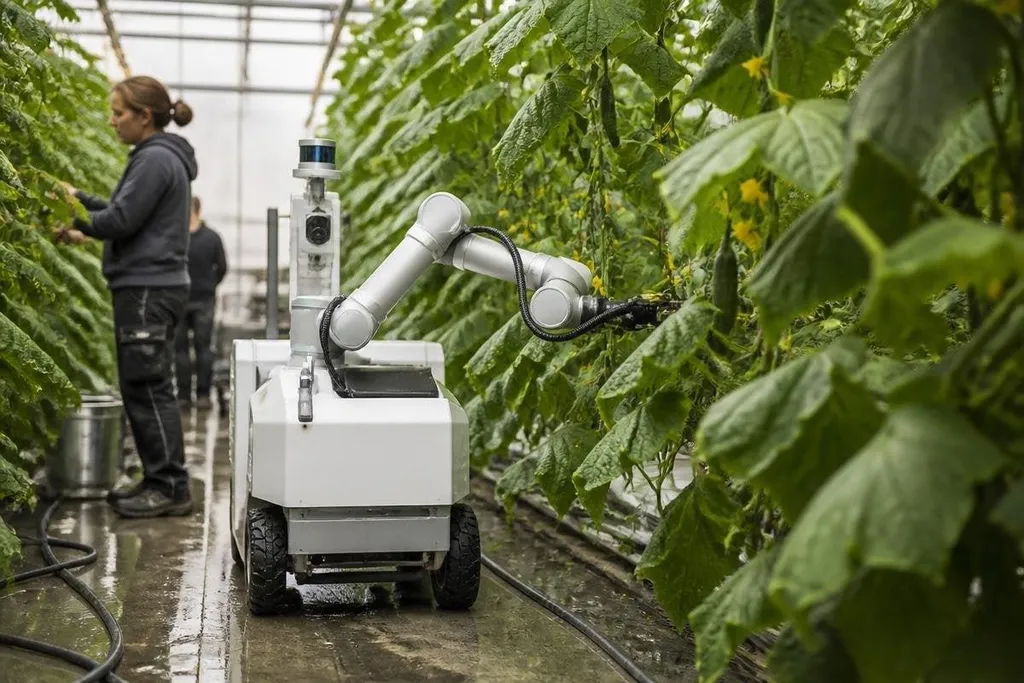
A greenhouse robot works in a narrow space filled with leaves, stems, cables, wet floors, and people. Future greenhouse robots will need to do more than move on a fixed route.
It will need to see each plant, choose a safe grip, and recover when the crop does not match the plan.
This article looks at the design tests that matter when you assess a greenhouse robot. No evidence pack was supplied for a named product, so the points below are requirements and checks, not claims about a specific system.
Quick read
- Plant work needs soft contact, close sensing, and careful motion.
- A robot that stops at every change in the crop may save labor but lose useful working time.
- Ask for field records, failure rates, service terms, and the task cost before you compare machines.
The crop is the work area
A factory floor gives a robot hard edges and repeatable paths. The growing space changes as plants grow. Leaves can cover fruit, vines can cross a row, and a worker may enter the same space without warning.
That puts vision near the center of the design. Cameras can locate stems, fruit, trays, or weeds, while depth sensors help the robot judge distance. The system still has to turn those images into a safe movement. Seeing a tomato is not the same as reaching it without touching the plant beside it.
The arm also needs force control. This lets the robot limit the push at the gripper instead of treating every object as a rigid part. A gripper built for plastic trays may damage a ripe fruit, so the end effector must match the crop and the task.
Movement matters more than a demo
Greenhouse floors may be damp, uneven, or partly blocked by hoses and plant waste. A mobile base needs enough clearance for the paths it will use, while its wheels or tracks must avoid damaging the floor and crop supports.
The robot's route also changes during a shift. It may need to stop for a person, return to a charging point, or move around a cart. A safe stop is useful, but repeated stops can cut the number of plants handled in an hour. That is why a buyer should ask for task records rather than a short video.
For a greenhouse buyer, greenhouse robotics reporting can connect a robot’s route, stop time, charging needs, and plant count to the work it completes. That record leads into the next test: what happens when the robot hands a task back to a person?
The hard part is the handoff
Picking or trimming is only one step. The robot must place the item in a tray, bin, or processing line without dropping it. One greenhouse system may also need to leave damaged fruit in a marked location or alert a worker when a plant needs a decision it cannot make.
That handoff should be measured as part of the full task. A robot that picks well but places slowly may add little value. The same applies to a machine that needs a person to guide its arm for every unusual plant.
The open question is how much crop variety one system can handle without a new gripper, new software settings, or repeated training. A machine built around one crop may work well in that row and offer little use elsewhere.
What buyers should ask for
The word “autonomous” tells you very little on its own. Ask for the conditions behind the claim and the cost of keeping the system running.
A practical buying checklist
- Name the task: Specify picking, scouting, pruning, transport, or another job before judging the robot.
- Request working records: Ask for hours run, plants handled, human interventions, and failed attempts.
- Check crop limits: Find out which plant types, growth stages, lighting conditions, and row layouts the system supports.
- Test the handoff: Watch where the crop goes after the robot touches it, including damaged or missed items.
- Price the people: Count setup, supervision, cleaning, repairs, charging, and seasonal changes.
- Set a stop rule: Agree on the output and safety results that would end the trial.
These checks also expose what remains unproven. A maker may show a clean row under good light, while your greenhouse has older plants, blocked paths, and several crews working nearby. Those differences belong in the trial plan.
What comes next
The next useful step is not a larger claim. It is a longer trial across the crop stages that cause trouble. A greenhouse robot earns its place when it can work through those changes, report its failures clearly, and cost less to run than the task it replaces. Until a supplier shows those records for your crop, I'd wait before buying.